
Cosplay Materials & Craft FAQ
EVA foam, Worbla, Flexi Paint, silicone molds: quick, practical answers to help you choose and work your cosplay craft materials with confidence.
Choosing your material
What EVA foam thickness and density should you choose for each piece?
These are general guidelines, not fixed rules: it all depends first on the piece you're building, your reference character, and the look you're going for. As a rough guide: 2 to 3 mm for fine details (small add-on surface elements — buttons, plates, tubes, rivets — that dress up an armor piece), 5 mm for lightweight armor, a helmet, or a curved piece, 6 to 8 mm for structural pieces like a chest plate or pauldrons, and 10 mm for pieces that take the most stress, like a sword or a shield. For bulky pieces that need sculpting or hollowing out (complex helmets, large props, bases), thicker blocks are also available, like our 5 cm-thick foam blocks, which give you enough material to carve into.
Density changes the equation independently of thickness: a medium-density foam (around 75 kg/m³, the standard you'll find at Cosplay Smart) offers a good balance of light weight, easy cutting, and detail retention. The higher the density, the smoother and denser the foam, which means it needs less primer to seal before painting. Low-density foam, on the other hand, is more porous and soaks up more paint: it usually needs several coats of primer for a clean finish. If you're just starting out, a medium-density foam like 75 kg/m³ is more than enough to get comfortable before investing in a higher density for your final pieces.
What's the difference between EVA foam and Worbla?
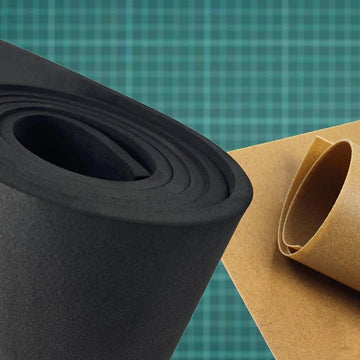
EVA foam is a closed-cell expanded foam: lightweight, flexible, compressible. Worbla is a solid thermoplastic (resin + fillers) that turns rigid as it cools and doesn't compress: it holds its shape and sharp edges perfectly. Many cosplayers combine both: EVA foam for volume and structure, Worbla as an outer layer for rigidity and clean finishes.
What is Polymorph used for?
Classic Polymorph is a reusable, heat-moldable plastic in pellet form: dipped in hot water, it turns soft, can be shaped by hand, then hardens again as it cools. It's especially useful for small rigid pieces, fasteners, or reinforcements, and it can also be used to make fake teeth or custom dental prosthetics. You can melt it down again as many times as you need if you're not happy with the result. Polymorph Crystal, on the other hand, stays transparent once cooled: it's notably used to embed LEDs in a piece, since light passes through the material.
Working the material
How do you use a heat gun without burning yourself or damaging the material?
Always keep the heat gun moving above the surface, never holding it still in one spot, and wear heat-resistant gloves. Heat gradually, from a reasonable distance: EVA foam is flammable. For Worbla, heat both sides evenly until it turns matte and feels soft to the touch before shaping it.
How do you glue EVA foam properly?
Heat and shape your piece first, let it cool completely so it holds its new shape, then glue without any tension on the seam. Contact cement gives a more durable bond than hot glue. Classic mistake to avoid: gluing a piece while it's still warm — the bond holds much less well.
How do you properly use contact cement on EVA foam?
Contact cement is the go-to adhesive for bonding EVA foam for good. Apply a thin, even coat to both surfaces you want to join, then let it air-dry for a few minutes: the glue should turn tacky to the touch — no longer sticking to your fingers but still tacky — before you assemble. Press the two surfaces firmly together the moment they touch: the bond forms almost instantly and leaves no room to reposition the piece, so line everything up carefully before pressing. Always work in a well-ventilated space, since the fumes are irritating.
How do you use a silicone mold for resin?
Pour your resin (UV or epoxy) into a clean, dry silicone mold, avoiding air bubbles by pouring slowly or tapping the mold. Let it cure for the time specified for your resin before demolding, then gently flex the mold to release the piece without breaking it.
Finishing & painting
How do you seal EVA foam before painting?
Foam is porous and soaks up paint if it isn't prepped first. The most common method is to lightly heat the surface with a heat gun to close the pores and smooth the grain, or to apply a primer in several thin coats before the final color.
How do you apply Flexi Paint to EVA foam?
Flexi Paint goes on directly over foam, with no primer required. Apply it in thin, even coats with a brush or airbrush: it has a matte finish and dries quickly. For the smoothest possible result, apply several thin coats one after another, lightly sanding between each one (wet sanding works great too and cuts down on dust) before adding the next coat. Once the piece is fully dry, a silicone or oil spray protects the paint and keeps pieces from sticking to each other.
Why does paint sometimes crack on foam armor?
It's almost always down to flexibility: foam moves with your body, and paint that's too rigid or applied too thick will crack wherever it bends. Thin coats of a flexible paint like Flexi Paint noticeably cut down on this risk compared to a classic rigid paint.
Safety & tools
Is working with EVA foam and Worbla dangerous?
These aren't materials you'd call toxic under normal use, but crafting does call for real precautions: burn risk from the heat gun, cut risk from the craft knife, and for any spray or airbrush painting, a ventilated space with a mask, goggles, and gloves is a must. Since EVA foam is flammable, keep it away from any open flame.
What tools do you need to get started in cosplay crafting?
A craft knife with a sharp blade for clean cuts, a heat gun to shape foam and Worbla, contact cement for assembly, and for finishing, a rotary tool (Dremel) that helps you sand, texture, and smooth edges. Nothing exotic is needed to get started.
How many times can you reuse a silicone mold?
A well cared-for silicone mold can be reused many times over: clean it gently after each pour, demold without forcing or tearing it, and store it flat, away from heat. Its lifespan mostly comes down to how well you look after it and the type of resin used, rather than a fixed number of uses.